
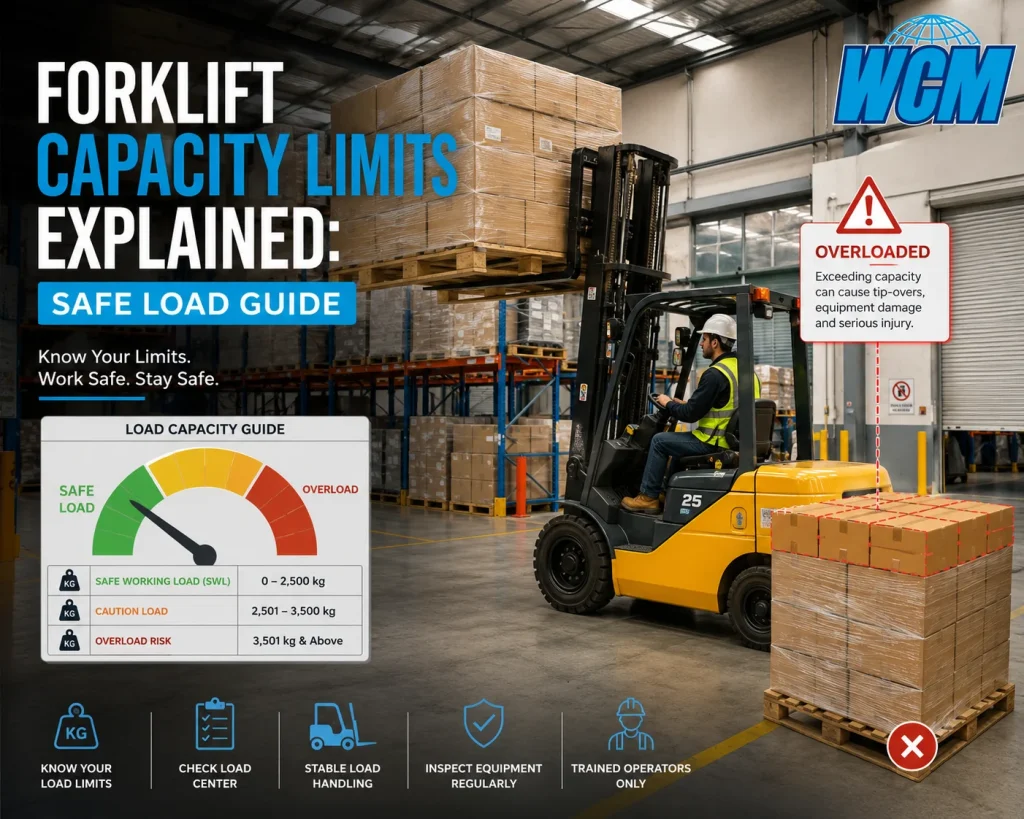
Forklift capacity limits define the maximum weight a forklift can safely lift at a given load centre, lift height, and configuration. Exceeding these limits can increase the risk of tip-overs and workplace injuries.
At WCM, we’ve spent over 40 years supplying construction and material handling machinery to businesses across WA. So in this guide, we are going to break down exactly how forklift load capacity works, how to read your data plate correctly, and how to keep every lift within safe limits.

Forklift Load Capacity Explained
A forklift’s load capacity is the maximum weight it can lift safely, and it depends entirely on how that weight is positioned, not just how heavy it is.
Think of a forklift like a see-saw:
- Front wheels → act as the fulcrum point, the pivot the whole machine balances around
- Rear counterweight → sits on one side of the see-saw
- Your load → sits on the other side
As long as the combined centre of gravity of the forklift and the load stays inside the “stability triangle” formed by the front wheels and the rear axle pivot, the forklift stays upright.
Push that balance point outside the triangle, and it tips.
This is why two forklifts with the same rated capacity can behave very differently depending on how, and where, they’re loaded.
Rated Capacity vs Actual Lifting Capacity
Rated capacity is the maximum weight stamped on the machine by the manufacturer, tested under ideal conditions:
- Mast upright
- Load centred at the standard load centre distance
- No attachments fitted
Actual lifting capacity is what the forklift can safely lift right now, in your yard, with your load.
Tilt the mast, shift the load centre forward, or bolt on an attachment → the actual capacity drops below the rated figure, sometimes by a lot.
Treating the rated number as a fixed ceiling, rather than a best-case scenario, is one of the most common mistakes we see operators make.
Why Forklift Capacity Can Change
Capacity is a moving target because forklift weight and balance shift constantly during operation.
A fully loaded two-tonne forklift can weigh close to five tonnes once you add the operator, fuel or battery, and the payload.
Because the whole machine is compact and heavy, small changes in load position or mast height move the centre of gravity noticeably. That’s why the same forklift can safely lift 2,500kg in one configuration and struggle with half that weight in another.
Forklift Capacity Plate and Load Ratings
The load capacity plate (also called the data plate) is the only reliable source for what your forklift can actually lift, and checking it before every shift is a legal requirement in Australia.
Painted numbers on the chassis are not your capacity rating. Manufacturers often stencil model numbers like “25” or “35” on the side of the machine, and operators regularly mistake these for tonnage figures. Always go by the stamped metal data plate.
Key Information on the Data Plate
Your data plate, usually mounted near the operator’s seat or on the mast, lists:
- Maximum lifting capacity in kilograms
- Rated load centre distance in millimetres
- Maximum lift height
- Mast tilt limits (most ratings assume a vertical mast)
- Unladen forklift truck weight
- Tyre specifications and inflation pressures
- De-rated capacity for any approved attachments

Load Centre and Rated Capacity
The load centre distance rating is built around the horizontal distance from the fork face to the centre of gravity of the load.
In Australia, AS 2359.1 sets the standard rating at 600mm, based on standard local pallet dimensions. A squarely loaded, evenly distributed pallet sits right at that mark.
Push that load centre out, say to 1,200mm for an oversized item like a long timber pack, and the actual lifting capacity drops by roughly half.
Double the load centre distance, halve the capacity. It’s one of the simplest rules in forklift operation, and one of the most overlooked.
Checking the Plate Before Operation
Verifying the data plate should be part of your daily pre-operational check, every time, regardless of how familiar you are with the machine.
If the plate is missing, painted over, or illegible → the forklift shouldn’t be operated until it’s replaced.
Factors That Affect Forklift Capacity
Five variables determine how much weight your forklift can actually handle at any given moment. Understanding each one is the difference between a routine lift and an incident.
Load Centre and Weight Distribution
The further the load’s weight sits from the fork face, the greater the tipping leverage.
Always push loads flush against the carriage backrest before lifting.
Uneven side-to-side distribution is just as dangerous, since it shifts the centre of gravity laterally and makes the forklift far more likely to roll during turns.
Lifting Height
Height and stability are directly connected:
- Mast lowered and vertical → stability margin of 30–50%
- Mast raised to full height → margin can fall to just 15–20%
As there are many types of forklifts, single-tyred forklifts lose stability sharply above roughly 4,000mm, while dual-tyred configurations hold a safer profile up to around 5,000mm. Some reach trucks retain as little as 40% of ground-level capacity at maximum extension.

Forklift Attachments
Every attachment, like a side-shifter, fork extension, or roll clamp, de-rates the machine in two ways:
- The attachment’s own weight subtracts directly from lifting capacity
- It pushes the load centre further forward, increasing leverage on the fulcrum
Typical reductions:
Attachment | Capacity Reduction |
Side-shifters | 5–15% |
Fork extensions | 10–30% |
Paper roll clamps | 20–40% |
Any fitted attachment must come with an updated, authorised load plate reflecting the de-rated figure.
Load Size and Shape
Irregular, top-heavy or sagging loads throw the centre of gravity off in ways the standard rating doesn’t account for.
- Plasterboard or roofing iron → sags at the ends, pulling weight outward and unbalancing the load laterally
- Liquid loads in unbaffled containers → the fluid keeps shifting during travel and can trigger a tip-over even well below rated capacity
Forks, Tyres and Forklift Condition
Worn forks and tyres quietly erode your safety margin.
- Fork heel wear beyond acceptable limits → weakens load-bearing capacity
- Stretched lift chains → need immediate replacement
- Tyre pressure drop on one side → tilts the whole stability triangle
Even a small rut or floor imperfection can be enough to trigger a lateral tip-over on a fully loaded forklift.
Risks of Exceeding Forklift Capacity
Overloading a forklift doesn’t just risk a fine; it risks lives and equipment.
Tip-Over and Loss of Stability
Once the combined centre of gravity moves outside the stability triangle, the forklift tips.
Sideways rollovers are the leading cause of forklift operator fatalities, largely because operators instinctively try to jump clear and get crushed under the overhead guard.
If a tip-over starts: stay in the cabin, keep the seatbelt on, and lean away from the direction of the fall.
Falling or Shifting Loads
Overloading puts extreme strain on the hydraulics and mast. A sudden stop or turn can send an unstable load sliding off the tines entirely.
Forklift Damage and Component Failure
Beyond the immediate safety risk, repeated overloading stresses hydraulic hoses, lift chains and structural welds, leading to premature failure and expensive downtime.
Safe Forklift Operation With Heavy Loads
Load Positioning and Fork Placement
Spread the tines as wide as the load safely allows and insert them fully before lifting, locking positioning pins where fitted to stop lateral slip in transit.
Safe Travel and Load Height
Travel with the load low, ideally 150–200mm off the ground, and tilt the mast back to cradle it securely against the carriage.
Attachments and Operating Conditions
On ramps or inclines: load faces uphill, drive forward going up, reverse going down. Never turn or load on a slope.
Operator Training and Workplace Safety
Maintain three points of contact when mounting or dismounting, keep pedestrians at least three metres clear, and brake gradually rather than sharply; a laden forklift can’t stop the way an empty one can.
Special Loads and Capacity Considerations
Long, wide, suspended or awkwardly shaped loads often fall outside a standard forklift’s design intent.
- Wide or sagging loads → need a certified spreader bar
- Suspended items → only ever rig from a proper jib attachment, never slung directly off the forks
- Unknown or uneven centre of gravity → do a low test lift of just a few centimetres first to check for tilt before travelling
In some cases, a standard counterbalance forklift isn’t the right tool at all, and a purpose-built side-loader or telehandler will do the job more safely.
Forklift Capacity Limits: Key Takeaways
- Forklift capacity is never a fixed number; it shifts with lift height, load centre distance, attachments and machine condition
- Always work from the stamped data plate, never painted markings
- Remember the core rule: double the load centre, halve the capacity
- Carry loads low, tilt the mast back, and respect the stability triangle on every lift, every shift
Ready to Find a Forklift That Matches Your Load Demands? Talk to WCM
Choosing the right forklift isn’t just about tonnage on a spec sheet. It’s about matching the machine, tyres, and attachments to the loads you handle every day.
Since 1982, Worldwide Construction Machinery has been Perth, WA’s trusted, family-owned supplier of construction and material handling machinery. Our team can walk you through capacity ratings, attachment de-rating, and which configuration actually suits your worksite, before you buy.
- 40+ years of local industry experience
- New and used forklifts with full warranty options
- Honest advice, not just a sales pitch
Explore WCM’s Forklifts for Sale
FAQs
What happens if the load centre is greater than the forklift’s rated load centre?
If the load centre exceeds the rated distance, the forklift’s lifting capacity decreases, increasing the risk of instability, tipping or load loss.
How do you determine the load centre of a forklift load?
Measure horizontally from the fork face to the load’s centre of gravity. For evenly distributed loads, this is typically half the load depth.
Can a forklift lift a load that is within its weight capacity but has a longer load centre?
Not necessarily. A longer load centre increases leverage, which can reduce the forklift’s actual lifting capacity below the load’s weight.
What should you do if the forklift capacity plate does not show your load height or load centre?
Do not assume the rated capacity applies. Consult the manufacturer or an authorised person for the correct capacity rating before lifting.
Can you use a forklift if the load is heavier than the capacity shown on the data plate?
No. Never exceed the forklift’s rated capacity. Use a forklift with sufficient capacity for the load, height, load centre and configuration.